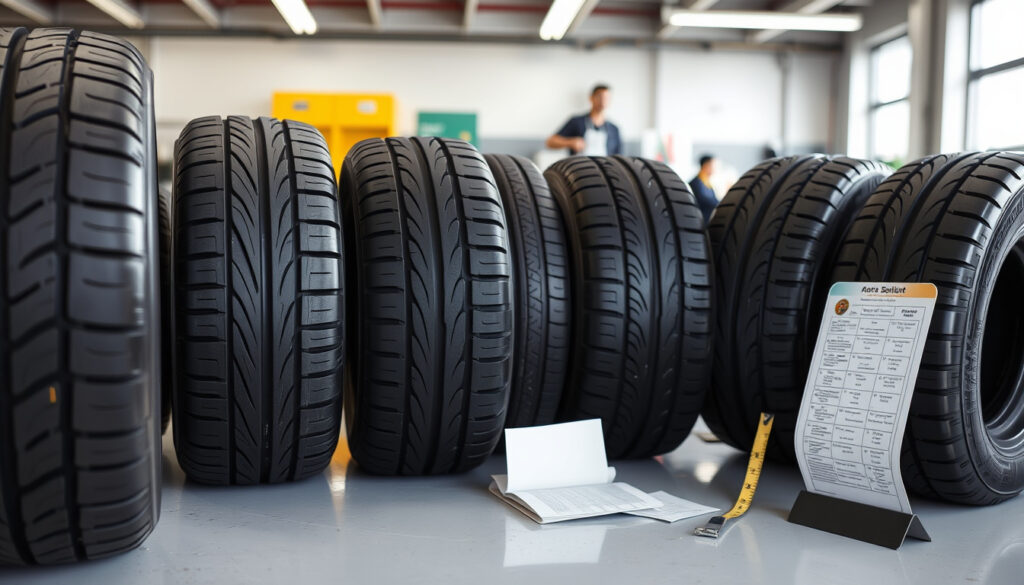
Tire Comparison: How to Compare Tires Side by Side
Tire size math isn’t guesswork, but most drivers treat it that way. This guide breaks down the measurements, tools, and performance trade-offs so you can compare tires with confidence—whether you’re replacing a set or choosing between brands.
Tire size formats: P-metric, Euro-metric, LT, and more ·
Typical tire diameter range: 15 to 22 inches (passenger cars) ·
Common tire width range: 195 to 285 mm ·
Speed rating letters: S (112 mph) to Y (186 mph)
Quick snapshot
- Tire size affects speedometer accuracy, load capacity, and vehicle handling (TireSize.com tire comparison tool)
- Using a tire size calculator is the most accurate way to compare sizes (Discount Tire tire size calculator)
- The exact impact of tire width on fuel economy varies by vehicle and driving conditions
- The best tire brand for a specific vehicle depends on individual preferences and driving needs
- Not applicable for this comparison-oriented topic
- Use the tools and knowledge below to compare current versus new tire sizes precisely
| Specification | Value |
|---|---|
| Tire diameter | Range 15-22 inches |
| Tire width | 195-285 mm |
| Aspect ratio | Typically 30-75 |
| Load index | 70-120 (corresponds to weight capacity) |
| Speed rating | S, T, U, H, V, W, Y, Z |
How to compare tires side by side?
Here’s the place to start: the side-by-side comparison is the core of any tire decision. Four measurements that do the real work — diameter, width, circumference, and speedometer error — and knowing them changes everything.
Using a tire size comparison tool
Many tire size comparison tools compare diameter, width, sidewall height, circumference, and revolutions per mile side by side (TireSize.com tire comparison tool). Some tire calculators also estimate speedometer reading or true vehicle speed after a tire-size change (TireSize.com tire comparison tool).
Understanding diameter, width, and circumference
Calculator.net states the diameter formula as wheel diameter plus 2 times section height, and section height equals aspect ratio multiplied by tire width (Calculator.net tire size calculator). The Discount Tire calculator presents side-by-side current and replacement tire measurements for sidewall height, section width, overall diameter, circumference, and estimated revolutions per mile (Discount Tire tire size calculator).
Checking speedometer differences
Speedometer readings change with tire size changes. Discount Tire’s example comparison between 205/60R16 and 225/50R17 shows revolutions per mile changing from 785.32 to 779.91, a difference of -5.41 (Discount Tire tire size calculator).
Tire-calc.com warns that tire-size differences greater than 3% are shown in red and are not recommended by that tool (Tire-calc.com tire size calculator). The implication: keeping your new tire within 3% of the original diameter prevents major speedometer and drivetrain issues.
What is the best tire comparison website?
A few tools dominate the space, each with a different strength. Here’s the landscape.
Tiresize.com
Tiresize.com offers a clean side-by-side visual comparison of diameter, width, sidewall height, circumference, and revolutions per mile (TireSize.com tire comparison tool). It also estimates speedometer reading after a tire-size change.
Calculator.net
Calculator.net provides detailed numerical differences and clearly states the diameter formula as wheel diameter plus 2 times section height (Calculator.net tire size calculator).
Tacomaworld.com
Tacomaworld.com is popular among truck and SUV owners for its community-driven fitment data and real-world tire swap experience.
1010tires.com
1010tires.com includes fitment verification alongside its comparison results, helping you check if the new tire actually fits your vehicle.
Discount Tire
Discount Tire’s tool is integrated with their retail stock, presenting side-by-side current and replacement tire measurements for sidewall height, section width, overall diameter, circumference, and estimated revolutions per mile (Discount Tire tire size calculator). The catch: dedicated enthusiasts (like those on Tacomaworld) prefer a community-driven database, while casual shoppers benefit from Discount Tire’s direct purchasing path.
No single site covers every need. Pick your tool based on whether you value raw specs, community fitment data, or a direct checkout button.
How to use a tire size calculator?
A tire size calculator is your math-checker. Here’s the step-by-step.
Entering current tire size
Tire size format is typically P215/65R15. You enter the current tire’s three-part code — width, aspect ratio, and wheel diameter.
Entering new tire size
You then enter the new tire’s size in the same format. The calculator computes the difference in diameter (Calculator.net tire size calculator).
Interpreting the results (diameter, width, sidewall, circumference)
Discount Tire’s example using 205/60R16 and 225/50R17 shows sidewall height changing from 4.84 inches to 4.43 inches, a difference of -0.41 inches; circumference changing from 80.68 inches to 81.24 inches, a difference of +0.56 inches; and tire height changing from 25.68 inches to 25.86 inches, a difference of +0.18 inches (Discount Tire tire size calculator).
Checking speedometer error
Speedometer error is shown as a percentage. Some calculators also estimate true vehicle speed after a tire-size change, which is critical for maintaining legal speed compliance and odometer accuracy (TireSize.com tire comparison tool). Tire-calc.com warns that differences greater than 3% are not recommended (Tire-calc.com tire size calculator). The pattern: the 3% rule is the industry’s safety benchmark — exceeding it means recalibrating your speedometer.
How to compare tires by brand?
Once the size math checks out, the next question is which brand delivers. Comparing brands means weighing performance ratings, price, warranty, and reputation.
Comparing performance ratings
Brands like Michelin, Bridgestone, and Goodyear have different performance characteristics. Tire ratings include treadwear, traction, and temperature — the Uniform Tire Quality Grading (UTQG) system, created by the NHTSA (U.S. vehicle safety regulator). Michelin USA advises comparing tires on performance criteria that matter to the driver rather than price alone (Michelin USA tire buying guide).
Comparing price and warranty
Warranty terms vary by brand. Michelin, Bridgestone, and Goodyear each offer different tread life warranties, typically ranging from 40,000 to 80,000 miles for passenger all-season tires.
Reading user reviews
Aggregated user reviews on platforms like Tire Rack provide real-world feedback on noise, comfort, and longevity. The trade-off: marketing claims versus actual owner experience across thousands of miles.
Checking brand reputation
Check brand reputation through independent tests and consumer reports. The implication: a premium brand often delivers better wet braking and longer tread life, but at a higher upfront cost — the math shifts depending on how long you keep the car.
How to compare tire performance?
Performance comparisons go beyond size — they tell you how the tire behaves on the road.
Dry and wet traction
Michelin USA lists wet braking as a key criterion for comparing tires (Michelin USA tire buying guide). Performance tires prioritize grip over tread life. All-season tires try to balance both. Winter tires use special rubber compounds for cold temperatures.
Handling and cornering
Wider tires improve grip but may reduce fuel economy and affect steering response. The exact impact of tire width on fuel economy varies by vehicle and driving conditions — that’s one of the uncertainties in the research.
Noise and comfort
Ride comfort is another criterion Michelin suggests (Michelin USA tire buying guide). Tread pattern and rubber compound determine cabin noise levels.
Fuel efficiency
Rolling resistance affects fuel consumption. Lower rolling resistance translates to better fuel economy, all else being equal.
Tread life
Michelin also lists tread life as a comparison criterion (Michelin USA tire buying guide). The trade-off for the buyer: winter tires sacrifice tread life for cold-weather grip, while all-season tires aim for a middle ground of 60,000 miles or more.
You can’t maximize all five criteria at once — choose the two that match your driving environment.
All-season tires balance performance and longevity, while performance tires prioritize grip over tread life. Winter tires have special rubber compounds for cold temperatures. The pattern: you can’t maximize all five criteria at once — choose the two that match your driving environment.
Comparison table: Key websites and tools
Three size calculators, one pattern: each gives you the same core measurements but with a different interface strength.
| Tool | Key features | Best for |
|---|---|---|
| Tiresize.com | Side-by-side visual comparison; speedometer estimate | General comparison |
| Calculator.net | Diameter formula display; detailed numerical differences | Understanding the math |
| Discount Tire | Integrated with retailer stock; revs per mile | Direct purchase |
| Wheel-Size.com | Supports metric & imperial; possible equivalents | Finding alternatives |
| 1010tires.com | Fitment verification included | Checking clearance |
Spec table: Tire size parameters
Six parameters, one frame: these are the specs every calculator compares.
| Parameter | Description |
|---|---|
| Section width | Tire width in mm (e.g., 205 mm for 205/60R16) |
| Aspect ratio | Sidewall height as % of width (e.g., 60 means 60% of 205 mm) |
| Wheel diameter | Rim size in inches (e.g., 16 inches) |
| Overall diameter | Wheel diameter + (2 × sidewall height) |
| Circumference | Tire’s outer rolling distance per revolution |
| Revolutions per mile | Times the tire rotates per mile |
Pros and Cons of Tire Comparison Tools
Upsides
- Instant side-by-side numerical differences
- Speedometer error estimation
- Visual comparison of two sizes
- Often free and no registration needed
Downsides
- Some tools limit comparison to two sizes
- No real-world performance data (noise, grip)
- Accuracy depends on correct input
- May not account for wheel well clearance on specific vehicles
Steps for a complete tire comparison
Follow these steps to compare tires methodically.
- Determine your current tire size (look on the sidewall)
- Choose a target tire size
- Use a tire size calculator (like TireSize.com tire comparison tool) to compare diameter, width, and circumference
- Check speedometer error: keep difference under 3%
- Check wheel well clearance by comparing width and diameter to your vehicle’s specs
- Compare brands on performance (wet braking, tread life, rolling resistance)
- Verify load index and speed rating meet your vehicle’s requirements per NHTSA (U.S. vehicle safety regulator)
- Read user reviews for real-world feedback
- Compare warranty terms across brands
- Make your purchase from a reputable retailer
tire-reviews.com, tiresize.com, youtube.com, reprints.theygsgroup.com, tiresize.com, carid.com, neotires.com
Frequently asked questions
What do the numbers on a tire mean? (e.g., 205/55R16)
205 is the width in millimeters, 55 is the aspect ratio (sidewall height as a percentage of width), and R16 is the rim diameter in inches. Calculator.net states the diameter formula as wheel diameter plus 2 times section height (Calculator.net tire size calculator).
Can I use a different tire size than recommended?
Yes, but keep the overall diameter within 3% of the original to avoid speedometer error and drivetrain issues. Tire-calc.com warns that tire-size differences greater than 3% are not recommended (Tire-calc.com tire size calculator).
How does tire width affect handling?
Wider tires generally improve grip and cornering stability but may reduce fuel economy and increase steering effort. The exact impact of tire width on fuel economy varies by vehicle and driving conditions.
What is the difference between all-season and summer tires?
All-season tires use a rubber compound that remains flexible in moderate cold and warm temperatures, offering balanced performance. Summer tires prioritize dry and wet grip at the cost of tread life and cold-weather capability. Winter tires use special rubber compounds for cold temperatures.
How often should I check tire pressure?
At least once a month and before long trips. Correct pressure is critical for safety, fuel economy, and tire longevity. Weekly checks are advised during temperature swings.
The Tire and Rim Association defines the standard format for tire size designation, ensuring uniformity across manufacturers.
The NHTSA sets tire safety standards and load rating guidelines to prevent overloading and heat-related failures.
For the U.S. driver, the choice is clear: use a tire size calculator to check the 3% rule, then cross-reference brand performance data on wet braking and tread life. Or risk a speedometer off by 3 mph at highway speed and a set of tires that wear out 10,000 miles early — that’s the consequence of skipping the math.
A wrong tire size can throw off your speedometer by 5% or more, which means the driver faces a real risk of unknowingly speeding or underreporting mileage, all because the circumference changed by less than an inch.
More related posts
 Mona Singh: Biography, Kona Kona Restaurant & Marriage
 In the Air Tonight by Phil Collins: Myths, Story & Legacy
 OG Anunoby: Family, Championship, and Career Stats
 7 Feet in Inches: Converter, Chart & Height Guide
 Candice King: Marriage, Divorce, Kids, and Net Worth
 Last Minute Elf on the Shelf Ideas – Quick No-Prep Setups for Busy Parents
 Lindsay Wagner: What Happened to the Bionic Woman Star
 Heather Cox Richardson: Partner, Marriage, Income, Politics
